


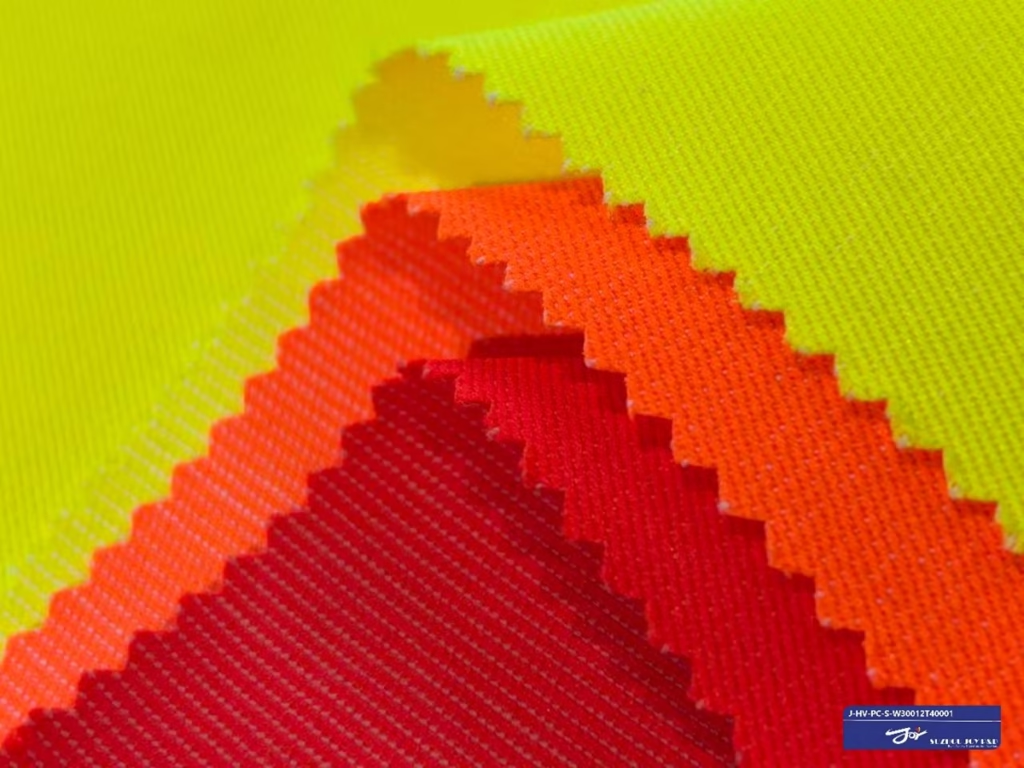

J-HV-PC-S-W150167502
Poly-Cotton T400 & Spandex Stretch Workwear Fabric with Twill Construction
A poly-cotton twill fabric combining T400 polyester and spandex for two-way stretch, with WR treatment, developed for professional workwear and selected high-visibility garment applications.
- Composition
- 36% polyester, 50% cotton, 12% T400 polyester, 2% spandex
- Weight
- 250 gsm (±5%)
- Usable Width
- 145 cm
- Construction
- Twill
- Treatment
- WR
- Care Instructions
- T400 Polyester & Spandex Blend
- Two-Way Stretch Twill
- 250 gsm Fabric Weight
- WR Treatment
- Abrasion Resistance: >40,000 Cycles
Overview
This poly-cotton stretch twill combines T400 polyester and spandex within a cotton-rich blend, offering a distinct material option for professional workwear development. The combination provides a basis for evaluating stretch requirements alongside the structure of a woven twill fabric.
With its medium-weight construction and WR treatment, the fabric can be considered for workwear programmes where material composition, movement requirements and surface water repellency influence fabric selection. Its available fluorescent colour options also support evaluation for selected high-visibility workwear projects, subject to colour-specific performance requirements.
Performance & Standards
The available technical data covers tensile and tear strength, abrasion resistance, dimensional stability, colour fastness and water vapour resistance. The TDS also records colour-performance conformity checks against EN ISO 20471 under specified conditions. Results should be interpreted in relation to the stated test methods, laundering conditions and applicable colourways.
Key Test Results
| Performance Area | Standard / Test Method | Reported Result |
|---|---|---|
| Tensile strength | EN ISO 13934-1:2013 | Warp: 1500 N; weft: 590 N |
| Tear strength | EN ISO 13937-2:2000 | Warp: 51 N; weft: 20 N |
| Abrasion resistance | ISO 12947 | >40,000 cycles at 12 kPa |
| Dimensional stability | EN ISO 6330 | Warp and weft: within ±3%; TDS references 40/60°C and 5/50 washes with tumble drying |
| Colour fastness to washing | EN ISO 105-C06 | Grade 4 for colour change and staining on cotton and polyester |
| Colour fastness to perspiration | EN ISO 105-E04 | Grade 4 under acid and alkaline conditions |
| Colour fastness to dry rubbing | EN ISO 105-X12 | Grade 4 |
| Water vapour resistance | EN ISO 11092 | Ret <5 m²·Pa/W |
Testing Notes
Dimensional stability data references washing at 40°C and 60°C, with 5 and 50 wash cycles and tumble drying. The applicability of individual washing conditions requires confirmation.
The TDS also records EN ISO 20471 colour-performance conformity under specified conditions, including after 50 washes and xenon exposure. These findings do not establish finished-garment certification or conformity across all colourways. Results may vary between fabric articles, and full technical documentation should be consulted for the applicable test conditions.
Applications
This fabric is suited to evaluation for professional workwear programmes requiring a woven stretch twill, with potential applications in industrial uniforms and selected high-visibility garments.
Typical Applications
- Industrial work trousers: For workwear designs where stretch and fabric durability are important material-selection considerations.
- Work jackets and utility garments: For coordinated professional workwear ranges requiring a consistent twill fabric.
- Maintenance and service uniforms: For occupational clothing programmes that prioritise movement requirements and practical fabric construction.
- Selected high-visibility workwear: For garment development using applicable fluorescent colourways, subject to the relevant colour-performance and finished-garment requirements.
Selection Considerations
Buyers should confirm the required stretch and recovery performance for the intended garment design, as the available TDS does not provide quantified stretch or recovery results. The suitability of individual fluorescent colourways and the applicable laundering conditions should also be verified before specification approval.
WR treatment should not be interpreted as waterproof protection. Where high-visibility compliance is required, the complete garment design and applicable certification requirements must be assessed separately.


Take the Next Step with This Fabric
Request a fabric sample or technical documentation to support your material evaluation.