


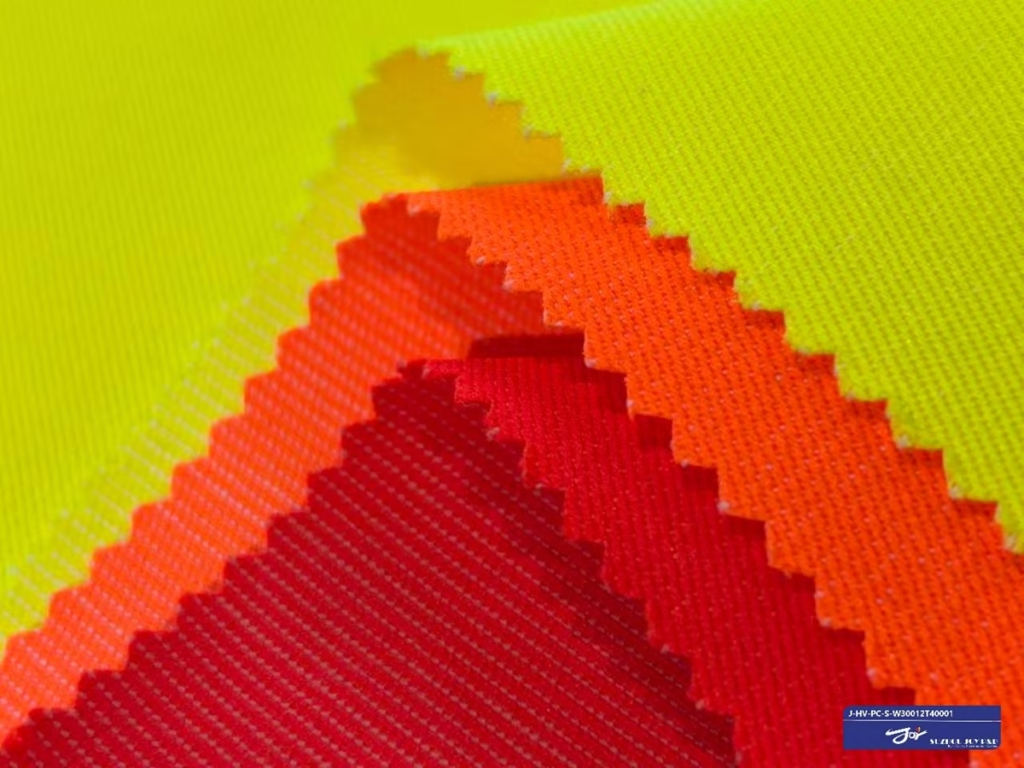

J-HV-PC-S-W1501202
Poly-Cotton Stretch Workwear Fabric with Twill Construction
A polyester-cotton-spandex two-way stretch twill fabric with WR treatment, developed for professional workwear and selected high-visibility garment applications.
- Composition
- 45% polyester, 52% cotton, 3% spandex
- Weight
- 290 gsm (±5%)
- Usable Width
- 148 cm
- Construction
- Twill
- Treatment
- Twill
- Care Instructions
- Poly-Cotton Spandex Blend
- Two-Way Stretch Twill
- 54% Warp & Weft Elongation
- Abrasion Resistance: >40,000 Cycles
- WR Treatment
Overview
This poly-cotton stretch twill fabric combines a cotton-rich blend with spandex to provide a woven material option for professional workwear requiring flexibility and a substantial fabric weight. Its two-way stretch construction makes it relevant to garment designs where freedom of movement is an important consideration.
The technical specification includes documented elongation, tensile strength, tear strength and abrasion resistance results, providing useful reference points for fabric selection. With WR treatment and high-visibility colour testing also recorded, the fabric can be considered for industrial workwear and selected high-visibility garment projects, subject to colourway-specific requirements and final garment evaluation.
Performance & Standards
The technical specification documents the fabric’s mechanical strength, stretch elongation, abrasion resistance, dimensional stability and colour fastness. High-visibility colour assessments and water vapour resistance results are also reported to support material evaluation.
Key Test Results
| Property | Test Method | Reported Result |
|---|---|---|
| Tensile Strength | EN ISO 13934-1:2013 | Warp: 1351 N; Weft: 793 N |
| Elongation | EN ISO 13934-1:2013 | Warp: 54%; Weft: 54% |
| Tear Strength | EN ISO 13937-2 | Warp: 51 N; Weft: 71 N |
| Abrasion Resistance | ISO 12947 | >40,000 cycles |
| Dimensional Stability After Washing | EN ISO 6330 | Warp and weft: reported as <±3% after 5 washes with tumble drying; TDS references 40°C/60°C |
| Colour Fastness to Laundering | EN ISO 105-C06:2010 | Grade 4 for polyester staining, cotton staining and colour change |
| Colour Fastness to Perspiration | EN ISO 105-E04:2013 | Grade 4 for reported alkaline and acidic staining assessments |
| Colour Fastness to Hot Pressing | EN ISO 105-X11:1996 | Grade 4–5 at 120°C under dry, damp and wet conditions |
| Colour Fastness to Dry Rubbing | EN ISO 105-X12:2016 | Grade 4 |
| Water Vapour Resistance | EN ISO 11092 | Ret <5 m²·Pa/W |
| High-Visibility Colour Coordinates and Luminance | EN ISO 20471:2013+A1:2016 | Reported conformity: as new, after 25/50 washes and after xenon exposure |
Testing Notes
Results are based on the supplied technical specification and may vary between articles. The applicable colourways and 25/50-wash conditions for high-visibility testing are not specified. Abrasion test details beyond the reported cycle count are unavailable; pilling and hydrostatic-head results are not reported. References to EN ISO 20471 and OEKO-TEX STANDARD 100 do not establish current product certification or finished-garment compliance.
Applications
This fabric is suitable for consideration in professional workwear projects where a stretch woven construction and durable fabric characteristics are important to garment selection.
Potential Garment Applications
- Workwear Trousers: A candidate for work trousers designed with movement and flexibility in mind.
- Workwear Jackets: Suitable for evaluation in work jacket designs requiring a stretch twill fabric.
- Workwear Coveralls: An option for industrial coveralls where fabric flexibility and mechanical performance are relevant selection criteria.
- High-Visibility Workwear: May be considered for selected high-visibility garment projects, subject to verification of the specific colourway, applicable testing conditions and finished-garment requirements.
Selection Considerations
Fabric selection should account for the intended working environment, garment construction, laundering requirements and applicable performance standards. High-visibility colour test records should be verified for the selected colourway and required wash durability. WR treatment should not be interpreted as certified waterproof protection.
Final suitability and regulatory compliance must be assessed for the finished garment and its intended use.


Take the Next Step with This Fabric
Request a fabric sample or technical documentation to support your material evaluation.