


J-HV-AS-P-R 15015001 FR 3 LAYER OPT.B
Multi-Norm Flame Retardant Hardshell Fabric with FR Knit Backing
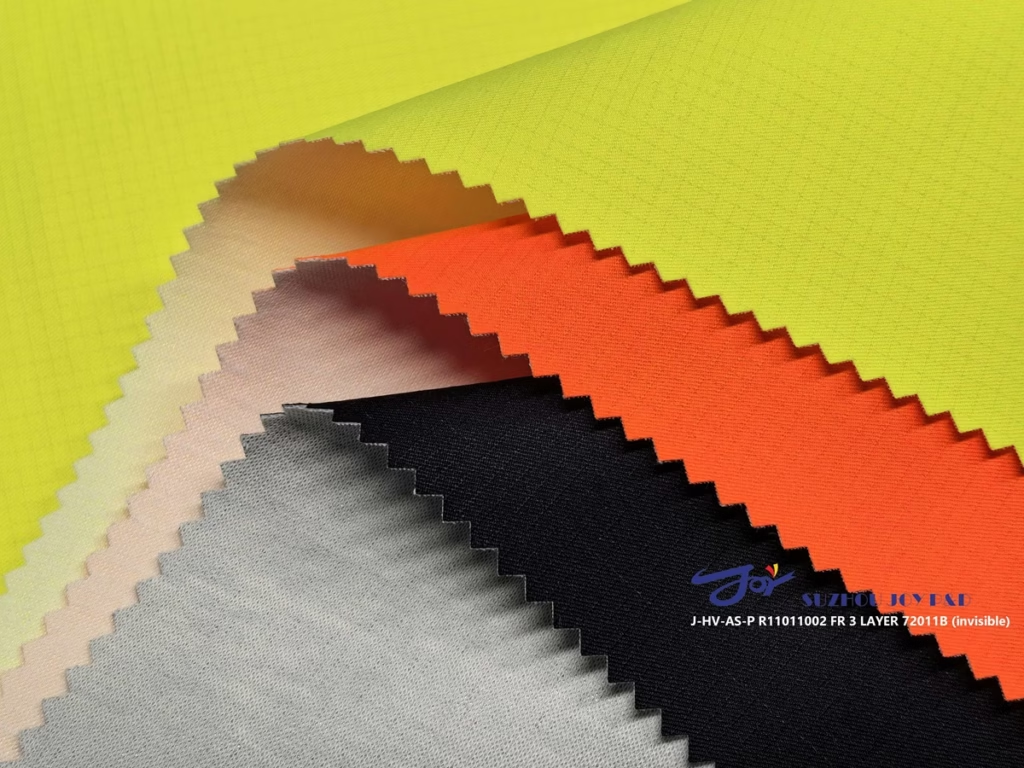
A three-layer multi-norm flame-retardant hardshell fabric combining a polyester/carbon outer shell, PU membrane and flame-retardant knit backing, with a visible anti-static grid for protective outerwear applications.
- Composition
- Shell: 98% polyester, 2% carbon; Inner layer: 60% modacrylic, 40% cotton
- Weight
- 280–300 gsm (±5%)
- Usable Width
- 56/57 inches
- Construction
- Dobby rib
- Treatment
- WR-FR BR PU membrane-FR knit
- Care Instructions
- Three-Layer Construction with FR Knit Backing
- Visible Anti-Static Grid
- Multi-Norm Heat and Flame Protection
- Electric Arc Protection — APC 1
- Industrial Washing Test Evidence
Overview
Designed for multi-norm protective outerwear, this three-layer flame-retardant hardshell fabric combines a polyester/carbon outer shell, a PU membrane and a modacrylic/cotton flame-retardant knit backing. Its visible anti-static dobby grid forms part of a construction developed for protective clothing used in demanding industrial environments.
With a specified weight of 280–300 gsm, the fabric brings together material properties relevant to heat and flame exposure, electric arc hazards, electrostatic performance and wet working conditions. It offers buyers a material option for protective jacket development where several performance requirements must be considered together, subject to the intended hazards and finished-garment validation.
Performance & Standards
This three-layer flame-retardant hardshell fabric has reported test results covering heat and flame protection, welding-related hazards, electric arc performance, electrostatic properties, limited liquid chemical protection and resistance to wet weather. Multiple assessments include industrial laundering pretreatment under ISO 15797.
Key Test Results
| Standard | Performance Area | Reported Result |
|---|---|---|
| EN ISO 11612:2015 | Heat and flame protection | A1+A2, B1, C1, D1, E3, F1 |
| EN ISO 11611:2015 | Welding-related protection | Class 2; limited flame spread A1+A2 |
| IEC 61482-2:2018 / EN 61482-1-2:2014 | Electric arc protection, box test | APC 1 |
| IEC 61482-1-1:2019 | Electric arc rating, open arc test | ATPV 10 cal/cm² |
| EN 1149-5:2018 / EN 1149-3:2004 | Electrostatic properties | Charge decay half-time t50 < 0.01 s; shielding factor S = 0.8; reported PASS |
| EN ISO 24232:2025 | Water penetration resistance | Class 4; >20,000 Pa, including after specified washing and mechanical conditioning |
| EN ISO 24232:2025 | Water vapour resistance | Class 3; Ret 22.2 m²·Pa/W |
| EN 13034:2005+A1:2009 / EN ISO 6530:2005 | Selected liquid chemical tests | Penetration Index 3 for four tested chemicals; repellency Index 3 for 30% sulfuric acid and 10% sodium hydroxide, Index 1 for o-xylene and 1-butanol |
| EN ISO 20471:2013 / RIS-3279-TOM:2016 | High-visibility colour testing | Reported PASS for tested HV yellow and HV orange; railway orange assessment applies to HV orange |
Testing Notes
Results are based on the JOY P&D technical specification revised on 17 October 2026, which references third-party laboratory reports and internal testing. Several assessments include 25 industrial washing cycles under ISO 15797; pretreatment conditions vary by test. Referenced reports include 2026CN0864/0865, 2025CN0829/0839 and SL32603353945701TX.
The underlying reports have not been independently reviewed here. Results may vary by colour and production lot. These fabric-level findings do not establish finished-garment certification or suitability for every workplace hazard.
Applications
Potential Applications
- Multi-Norm Protective Jackets: Outerwear developed for industrial workplaces where heat and flame protection, electrostatic performance and resistance to wet conditions may be required together.
- Welding Protective Outerwear: Protective jackets and related garments designed for welding-related hazards, subject to garment construction and the intended exposure conditions.
- Electric Arc Protective Clothing: Protective outerwear developed for workplaces with assessed electric arc hazards, where the fabric’s reported arc performance can inform material selection.
- Protective Rainwear & Outerwear: Weather-protective garments for industrial work environments requiring a combination of water resistance and specified protective properties.
- High-Visibility Protective Workwear: Protective outerwear incorporating tested high-visibility yellow or orange fabric variants, subject to colour, garment design and visibility requirements.
Material Selection Considerations
This fabric may be considered when protective outerwear requires several performance characteristics within one three-layer material construction. Selection should account for the intended workplace hazards, required protection levels, garment design, seam construction, closures, comfort and laundering conditions.
Electric arc performance should be evaluated against the applicable hazard assessment rather than relying on the reported ATPV or APC classification alone. Water resistance measured on the fabric does not establish the waterproof performance of a finished garment, particularly at seams and openings.
High-visibility test results apply to the specified colour variants and should not be extended to other colours without supporting evidence. Finished garments require appropriate design, testing and conformity assessment against the standards relevant to their intended use.

Take the Next Step with This Fabric
Request a fabric sample or technical documentation to support your material evaluation.