


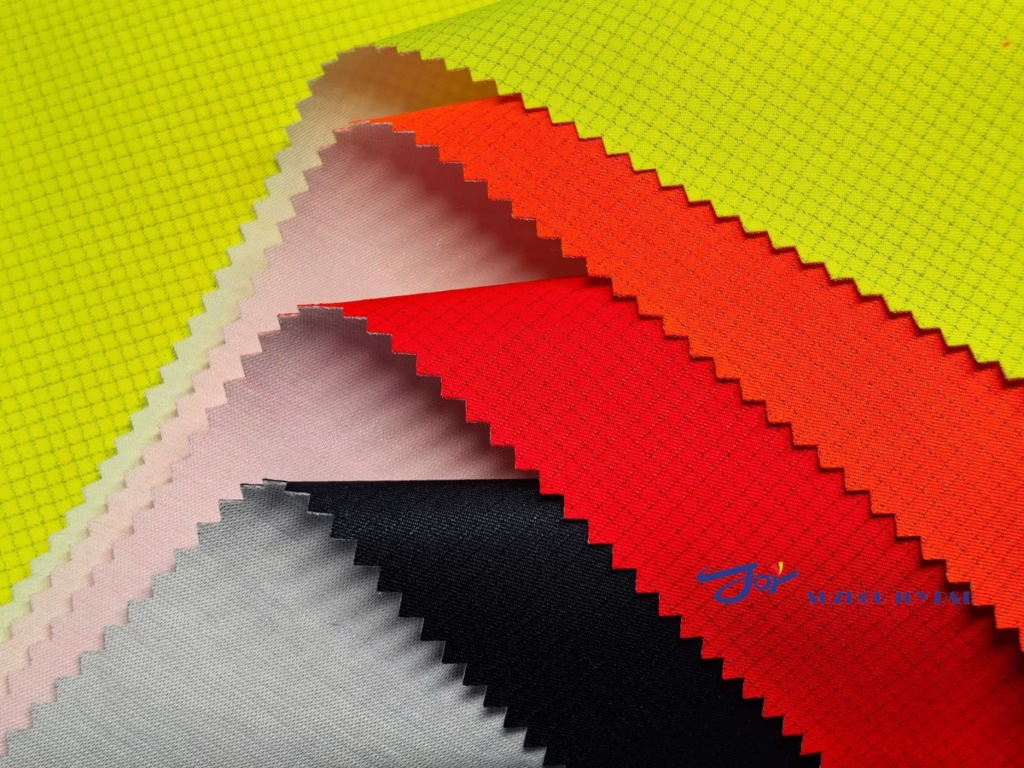

J-HV-AS-P-R 30030001 FR 2 LAYER B
Flame Retardant Two-Layer Protective Fabric
A two-layer flame-retardant protective fabric with a 98% polyester and 2% carbon outer shell and PU membrane, developed for protective outerwear requiring water penetration resistance and electrostatic performance.
- Composition
- Shell: 98% polyester / 2% carbon
- Weight
- 250 gsm (±5%)
- Usable Width
- 56/57 in (approx. 142–145 cm)
- Construction
- Rib
- Treatment
- WR-FR BR PU membrane
- Care Instructions
- Two-Layer Protective Construction
- Limited Flame Spread Performance
- Tested Water Penetration Resistance
- Electrostatic Performance
- High-Visibility Colour Options
Overview
This two-layer protective fabric is designed for outerwear applications where resistance to wet conditions, limited flame spread and electrostatic performance are relevant to material selection. Its membrane-based construction supports the development of protective garments intended for demanding working environments.
The fabric combines a functional protective surface with tested performance characteristics relevant to industrial workwear. High-visibility colour options also allow buyers to consider the material for protective outerwear programmes with specific visibility requirements, subject to the selected colour and finished-garment design.
Performance & Standards
This fabric has been evaluated for limited flame spread, resistance to liquid chemical penetration, protection against rain, electrostatic performance and high-visibility colour properties. The results below summarise selected third-party laboratory test data for material assessment.
Key Test Results
| Standard / Test Area | Test Result | Reported Classification |
|---|---|---|
| EN ISO 14116:2015 — Limited Flame Spread | Outer and inner surfaces tested as received and after 25 washes at 60°C | Index 1 |
| EN 13034:2005+A1:2009 — Liquid Chemical Penetration and Repellency | EN ISO 6530:2005: 0% penetration in warp and weft for 30% sulfuric acid, 10% sodium hydroxide, o-xylene and 1-butanol. Repellency ranged from 81.2% to 96.7%. | Repellency Index 2–3, depending on chemical and direction |
| EN 343:2019 — Water Penetration Resistance | >20,000 Pa as received and after 15 washes, abrasion, flexion and oil/fuel exposure | Class 4 |
| EN 343:2019 — Water Vapour Resistance | Ret 14.58 m²·Pa/W | Class 4 |
| EN 1149-5:2018 — Electrostatic Performance | EN 1149-3:2004 Method 2: charge decay half-time t50 <0.01 s; shielding factor S 0.82 | Pass |
| EN 20471:2013 — High-Visibility Colour Performance | Fluorescent yellow, orange and red: colour coordinates tested as received, after washing and after xenon exposure | Pass for the tested colours |
| RIS-3279-TOM:2016 — Railway High-Visibility Orange | Railway high-visibility colour evaluation | Pass |
Testing Notes
Results are taken from the supplier’s technical data sheet dated 31 July 2026, referencing third-party laboratory reports. The listed tests have different preconditioning and wash-cycle requirements; results should not be assumed to apply uniformly to every colour or finished garment. EN ISO 14116 Index 1 indicates limited flame-spread performance and does not establish higher-level heat or electric-arc protection. Full reports and suitability for a specific garment design should be confirmed with JOY P&D.
Applications
Potential Applications
This fabric may be considered for protective outerwear programmes where wet-weather performance, limited flame spread and electrostatic properties are relevant to the intended working environment.
- Protective Rainwear and Outerwear: Suitable for evaluation in work jackets, rainwear and protective outer layers designed for wet working conditions.
- High-Visibility Protective Outerwear: An option for workwear programmes requiring fluorescent colour performance, subject to the selected colourway, garment construction and applicable visibility requirements.
- Industrial Protective Workwear: A potential material choice for industrial outer garments where multiple fabric performance characteristics must be assessed against defined workplace hazards.
Material Selection Considerations
The fabric should be selected according to the hazards, garment design and performance requirements of the intended application. Its limited flame-spread classification should not be interpreted as evidence of protection against high heat, welding hazards or electric-arc exposure.
Water resistance, electrostatic performance and high-visibility properties must also be considered in relation to garment construction, seams, additional components and the selected colourway. Fabric-level test results do not establish compliance or certification of the finished garment.
Buyers are encouraged to confirm the relevant test reports, available colour options and application requirements with JOY P&D before finalising material specifications.


Take the Next Step with This Fabric
Request a fabric sample or technical documentation to support your material evaluation.