


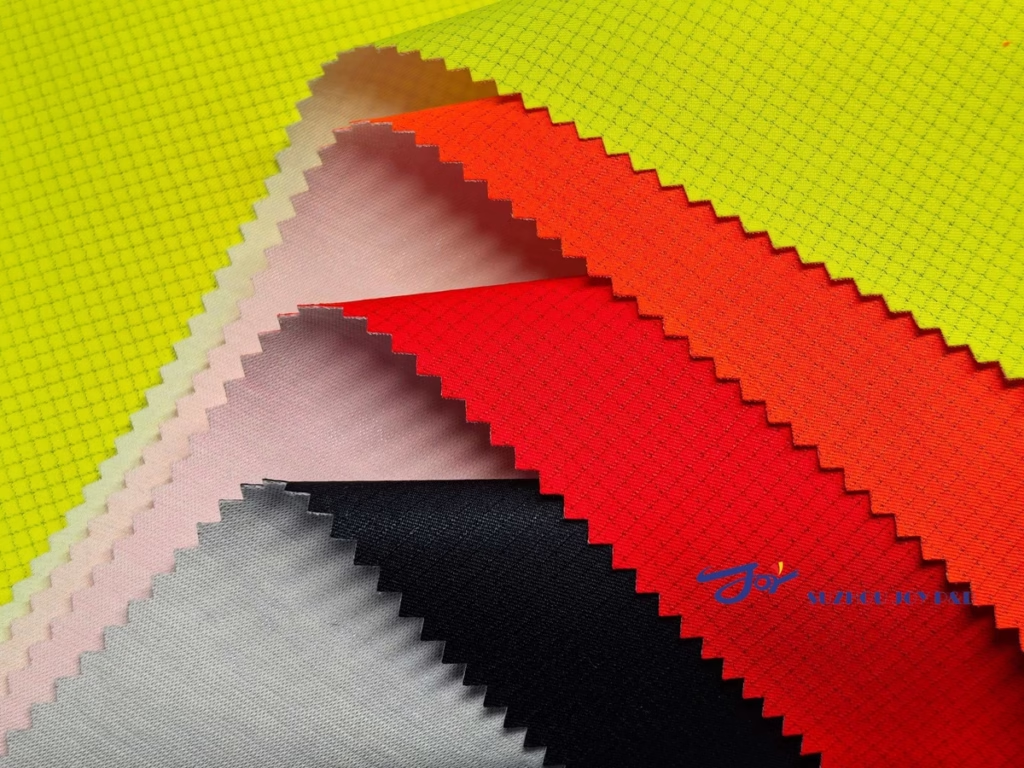
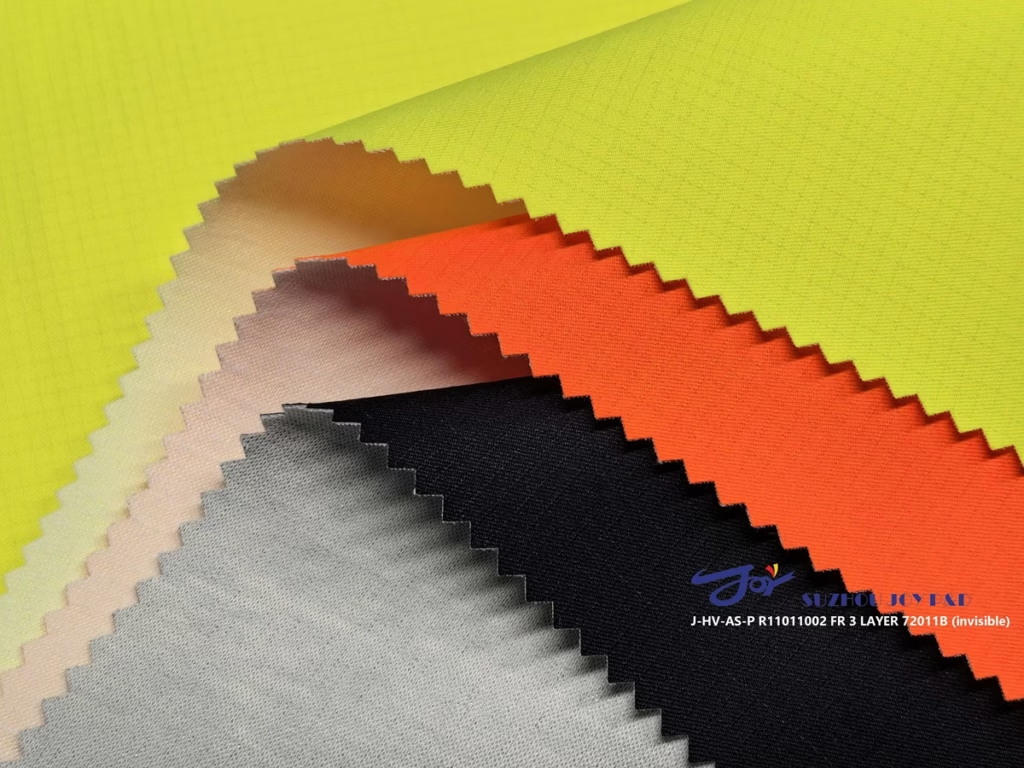
J-HV-AS-P R11011002 FR 3 LAYER
Multi-Norm Flame Retardant Hardshell Fabric
A stretchable three-layer flame-retardant hardshell fabric combining a polyester/carbon outer shell, PU membrane and protective inner layer, developed for multi-norm protective jackets.
- Composition
- Shell: 98% polyester / 2% carbon; Inner layer: 55% modacrylic (Protex) / 37% cotton / 8% aramid
- Weight
- 280–300 gsm (±5%)
- Usable Width
- 56/57 in (approx. 142–145 cm)
- Construction
- Twill rib
- Treatment
- WR-FR BR PU membrane-FR knit
- Care Instructions
- Multi-Norm Protection
- Three-Layer Hardshell Construction
- Stretchable Fabric Structure
- Tested Water Penetration Resistance
- High-Visibility Colour Options
Overview
J-HV-AS-P R11011002 FR 3 LAYER is a multi-norm flame-retardant hardshell fabric designed for protective jackets used in demanding industrial environments. It brings together protection-related properties relevant to heat and flame, welding hazards, electric arc exposure and electrostatic risks, alongside tested resistance to water penetration.
The fabric is described as stretchable and soft, supporting protective jacket development where mobility and protective performance are both important. Tested high-visibility colour options provide additional flexibility for workwear programmes with specific visibility requirements.
Performance & Standards
Third-party laboratory testing covers multiple protective performance areas, including flame and heat exposure, welding hazards, electric arc, electrostatic properties, limited liquid chemical protection, water penetration resistance and high-visibility colour performance.
Key Test Results
| Standard | Performance Area | Test Result |
|---|---|---|
| EN ISO 11612:2015 | Heat and flame protection | A1+A2, B1, C1, D2, E3, F1 |
| EN ISO 11611:2015 | Welding protection | Class 2; A1+A2 |
| EN 61482-2:2020 | Electric arc protection | APC 1 |
| IEC 61482-1-1:2019 | Arc thermal performance | ATPV 13 cal/cm²; ELIM 9.8 cal/cm² |
| EN 1149-5:2018 | Electrostatic performance | Charge decay test: PASS |
| EN 13034:2005+A1:2009 | Limited liquid chemical protection | Tested liquid penetration and repellency; results vary by chemical |
| EN ISO 24232:2025 | Water penetration and water vapour resistance | Water penetration >20,000 Pa, Class 4; Ret 14.3 m²·Pa/W, Class 4 |
| EN ISO 20471:2013+A1:2016 | High-visibility colour performance | HV Yellow, Orange and Red: PASS |
| RIS-3279-TOM:2016 | Railway high-visibility orange | HV Orange: PASS |
Testing Notes
Results are based on third-party laboratory testing of the specified fabric configurations. The TDS records ISO 6330 washing at 60°C for 25 cycles with tumble drying for the listed protection tests; individual methods and pretreatments vary. High-visibility colour results apply to the tested yellow, orange and red variants. Performance may vary by article and colour. Fabric test results do not constitute certification of a finished garment.
Applications
Recommended Applications
Multi-Norm Protective Jackets
Suitable for the development of protective jackets intended for industrial workplaces where flame, heat, welding and electric arc hazards may need to be addressed together. Final garment suitability depends on the applicable protection requirements and garment-level assessment.
Protective Rainwear & Outerwear
A potential option for protective outerwear requiring resistance to water penetration alongside flame-retardant properties. The three-layer construction and documented water penetration testing support consideration for applications involving wet working conditions.
High-Visibility Protective Outerwear
Suitable for consideration in high-visibility protective jacket programmes using the tested yellow, orange or red colour variants. Visibility-related performance must be assessed against the requirements of the finished garment, including its design and reflective components.
Selection Considerations
This fabric is intended for protective outerwear projects involving multiple performance requirements. Buyers should confirm the required protection levels, colour variant, laundering conditions and finished-garment compliance before specification. Fabric-level test results do not automatically establish certification or suitability of the completed garment.

Take the Next Step with This Fabric
Request a fabric sample or technical documentation to support your material evaluation.